Gerdoo
Sama II
Sama II
Couldn't load pickup availability
Share
The dance of Sama has four stages. The ceremony begins in the First Selam, as the dervish sheds the black Kherghe (cloak) to reveal the white Tennure, signaling a soul’s awakening from earthly ego. In the Second Selam, the hands shift to become a bridge—the right turned toward the sky to receive grace and the left toward the earth to bestow it. The Third Selam is the peak of rapture, where both hands are often raised in total surrender as the self dissolves into the divine. Finally, the Fourth Selam marks the return; the dervish completes the rotation and returns to their station, carrying the peace and geometry of the heavens back into the world of form.
The Alchemy of Wood & Spirit
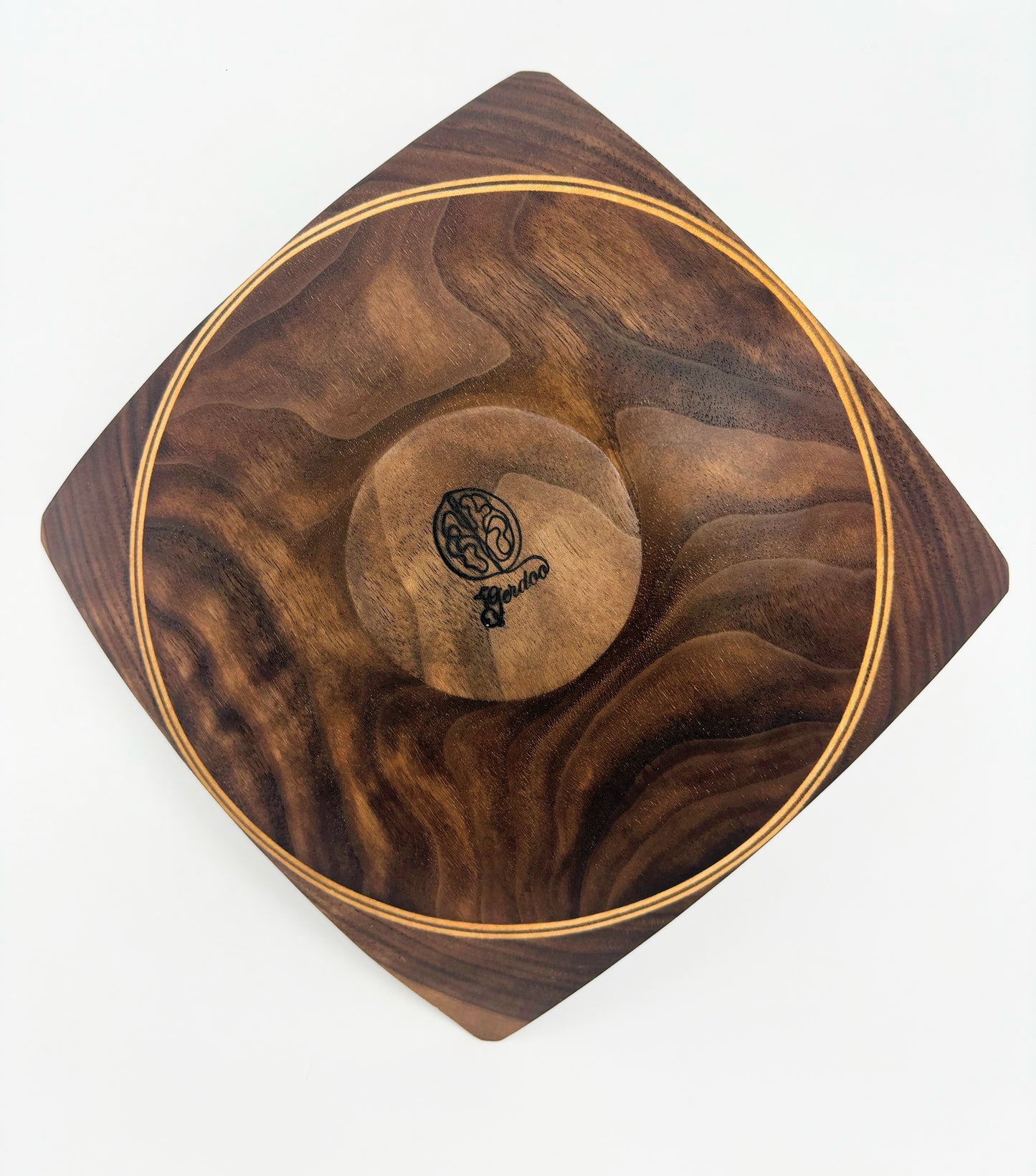
The dark walnut represents the Kherghe, the black cloak of the dervish symbolizing the heavy, earthly world and the ego. The maple star at the center represents the transition into the white Tennure, the radiant robe that signifies clarity found at the heart of the spiritual dance.
The Gereh’s Lineage
Both patterns in this series originate from a single design found in the Tomb of Majlesi in Isfahan. In traditional geometry, a design’s name often reveals its underlying structure. This specific motif is known as Davazdah-o-Hasht-e-Gardoon, which translates to "Twelve and Rotating Eight."
The winged edges of the bowl capture the physical momentum of the dervish, frozen in a state of constant ascent. While the dervish often acts as a bridge between different realms, there is a profound moment of total surrender where both hands are raised toward the sky. This gesture, mirrored in the upward sweep of the wood, represents a complete immersion in a higher state of being, letting go of the world entirely to witness a sense of universal oneness.